Store energy. Cut costs. Add resilience.
Battery Energy Storage Systems
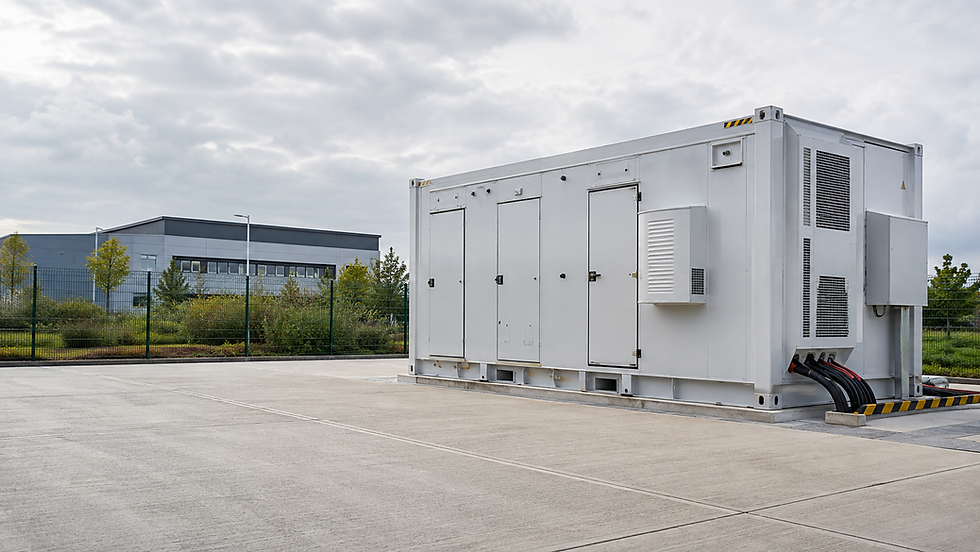
A Battery Energy Storage System (BESS) stores electricity when it is low-cost or surplus and releases it when demand or prices are higher. Businesses can use BESS to reduce energy costs through peak shaving, load shifting and increased use of on-site solar. With the right control and trading strategy, batteries can also access additional revenue opportunities through energy trading and grid-balancing services, helping optimise returns while supporting a more stable and flexible electricity network.
Get a free sizing + ROI estimate in 48 hours
- ✅ Bill + half-hourly data review
- ✅ Recommended battery size + operating strategy
- ✅ Budget cost + payback range

Why install battery energy storage (BESS)?
1. Reduce and Control Energy Costs
- A BESS can charge when electricity is cheaper or when solar generation is surplus, then discharge during higher-cost or high-demand periods. This helps businesses reduce peak demand, shift energy usage and maximise on-site renewable power.
2. Create Additional Revenue Opportunities
- With the right route to market and trading strategy, a BESS can participate in energy trading, price arbitrage, the Balancing Mechanism and other grid-flexibility services. Combining these applications can create multiple potential revenue streams.
3. Improve Resilience and Support Business Growth
- Battery storage can be configured to provide backup for critical operations, support EV charging and manage increased demand from electrification. It can also help businesses operate effectively where grid capacity is constrained.
4. Invest in a Flexible, Future-Ready Energy Asset
- For investors and asset owners, a BESS can provide a scalable infrastructure asset with potential income from energy savings, trading and grid services. It also supports renewable generation, grid stability and the UK’s transition to a more flexible energy system.

What you’ll get
Battery size recommendation (kWh) + power rating (kW)
Single-line diagram / basic design pack
Operating strategy (e.g., peak shave, PV maximize, backup, EV support)
Budget CAPEX/OPEX and expected savings
Installation programme and commissioning plan
Typical use cases

✓
Commercial/industrial sites with high peak demand
✓
✓
Solar PV + battery to increase self-consumption
✓
✓
EV charging hubs needing peak support
✓
Grid-constrained sites avoiding expensive upgrades
✓
✓
Critical operations needing backup
✓
Frequently asked questions
How big should my BESS be?
Usually based on your peak demand, tariff structure, load profile, and goals (peak shaving vs backup vs PV optimisation). A quick assessment using half-hourly data gives the most accurate answer.
Do I need DNO approval?
Often yes, depending on export capability and how the system connects/operates. We design around your constraints and handle the application route where needed.
What’s the typical payback?
Varies widely by tariff and use case. Peak shaving + time-of-use arbitrage + PV optimisation generally improves returns; backup-only projects are more resilience-driven than ROI-led.